“Man is the only being that knows death; all others become old, but with a consciousness wholly limited to the moment which must seem to them eternal” - Oswald Spengler
I’ve never been a fan of absolute statements about life like “The four paths to enlightenment” or “the Ten Commandments”. The idea that something as complicated as achieving enlightenment or understanding how to act could be distilled down into a finite set of exact statements is ridiculous. Unfortunately, as we explored in the previous chapter, we humans like finite things. We like pattern and structure and if you don’t think about it too hard you can sometimes take comfort in these sort of simplistic exact statements about the world.
The reason I try to make this point is because I would like to use one of these such numerically absolute statements, but with the caveat that I recognize from the outset that it is not a complete or exact list by any means. Think of it as a convenient way of organizing an idea in your head. When you undoubtedly think of contradiction, just know that I understand; you are not wrong, and yes we probably missed something, and maybe it’s a combination of two or more of the items on this list, but no need to worry because we recognize it’s flawed - it’s just a place to start.
Before we get to the framework itself, it’s worth pausing on just how deep the death awareness rabbit hole goes — because it’s deeper than most people realize.
Three psychologists — Sheldon Solomon, Jeff Greenberg, and Tom Pyszczynski — spent the better part of their careers studying what happens when you remind people that they’re going to die. Their work, which they eventually compiled in a book called The Worm at the Core, produced hundreds of experiments under the banner of Terror Management Theory. The results are, honestly, kind of unsettling.
In one of their early studies, they asked a group of municipal court judges to set bail for an alleged prostitute. Routine case, standard task. But half the judges were first asked to fill out a short questionnaire that included questions about their own death — nothing dramatic, just “what do you think happens to you when you physically die?” and “describe the emotions the thought of your own death arouses in you.” The judges who got the death reminder set bail at an average of $455. The control group? $50. Same case, same defendant, nine times the punishment — just because someone nudged them to think about dying for a few minutes beforehand.
And it wasn’t a fluke. Hundreds of studies replicated the pattern across different contexts. Remind people of their mortality and they become more patriotic, more defensive of their cultural worldview, harsher toward people who are different from them, and more generous toward people who are similar. In one study, just walking past a funeral home was enough to make people express stronger support for their own national or religious identity. They weren’t consciously thinking “I’m going to die, so I’d better wave a flag.” The death awareness was operating underneath, shaping behavior without anyone noticing.
What these studies reveal is something we touched on in The Immortal Replicator: our awareness of death doesn’t just make us avoid danger. It makes us build things. Systems of meaning, group identities, legacies, beliefs — all of it, at least in part, driven by the need to feel like some piece of us will outlast our body. The question is: can we map those behaviors into something coherent?
Okay here we go. So you want to live forever, right? Well you probably weren’t conscious of this fact before, but it’s the truth, and I’m here to tell you that you can do exactly that. Don’t worry this isn’t a cult or budget-rate cryogenics, this is simply a framework for helping you understand all the various ways you can live beyond your mortal self. Best part is that you’ve already been pursuing this whether you recognized it or not.
There are many ways to live forever and it’s best to think of these pursuits as projects; we call them Immortality Projects. Like regular projects you can have many on the go at the same time, switching between them when they require your attention. However unlike regular projects, you can never truly complete them. They’re the painting that is never quite done, or the report you can always keep revising. They are:
- The Biological Project: The original and most popular Immortality Project; the pursuit of health, longevity, and immortality through offspring.
- The Status Project: The pursuit of immortality through the memories of others; synonymous with legacy or fame.
- The Creative Project: Leveraging creative motivations in art, science, literature, etc. as a means of discovering/reflecting on the world/life in order to reconcile one’s own mortality.
- The Community Project: Effectively achieving immortality through association with a group, whether it be a religion, nation, sports team, political ideology, etc.
- The Natural Project: Reconciling one’s own mortality through a connection with nature, resulting in a belief of being part of one large “life force”.
Now, before we get any further, I have to make a point that I will continue hammering home: No one project is any better or worse than the other - they are all equal. If you’ve understood The Immortal Replicator, then you’ll remember that life truly has no meaning, but that we should still make the most of it. The order of the projects above is of no relevance, it is not a ranking. The projects do however tend to have a relationship to their adjacent counterparts, which means the best way to represent them is probably more like a circular diagram.
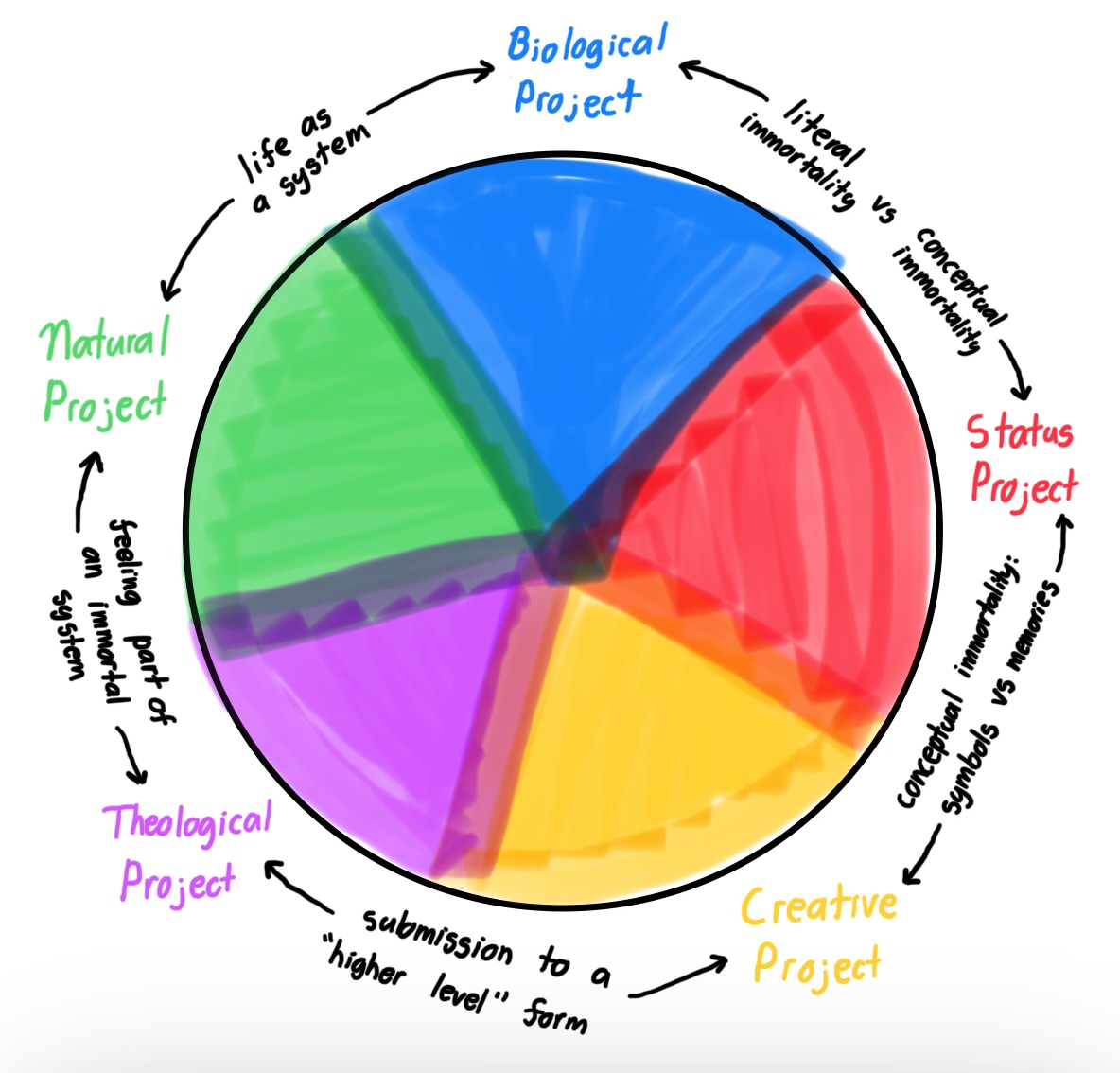
Once again, this whole system is a gradient, I’ve chosen to represent it with 5 projects but you could very well try and do it with 3 or 10. Remember, any time someone tries to apply a finite number to anything as abstract as psychology they are usually kidding themselves. The point here is that each of these 5 projects have overlap, as we will talk about in each of their respective chapters. Most people have multiple projects on the go at once and so a pie chart proves to be a useful way to represent each person’s current immortality projects.
Immortality Pies
Each of the five projects are equivalent in the sense that no one is better or worse than the other. Our projects motivate us to action but aside from that, they have no higher purpose. They are projects we can never complete and our progress on them really doesn’t matter either. The hope here is that by understanding everyone’s different projects we are better able to empathize with those around us.
Introducing the Immortality Project Pie Chart:
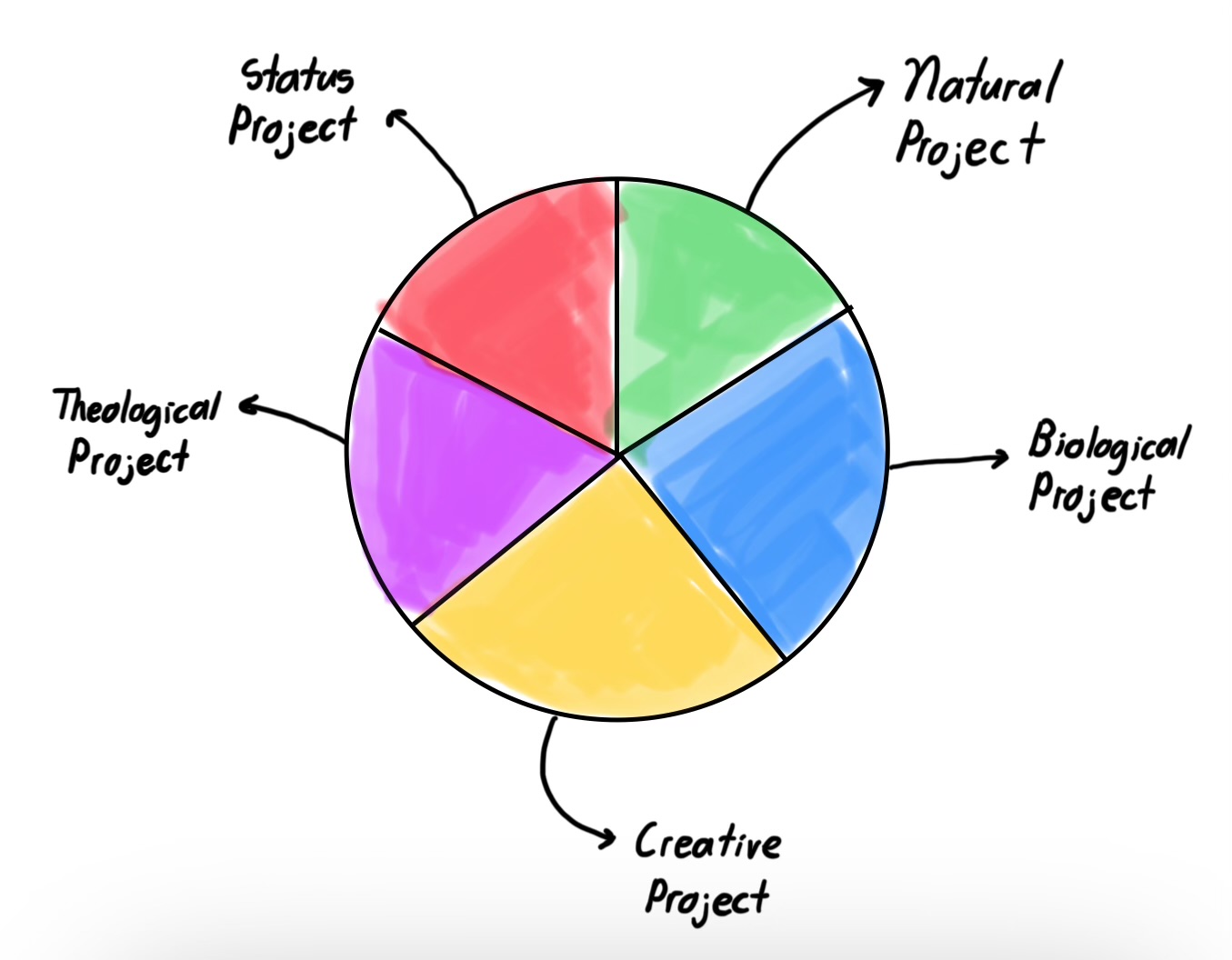
Everyone has a pie chart, whether they realize it or not. When we enter this world, our only instinct/motivation is to survive, meaning our pie chart is entirely Biological.
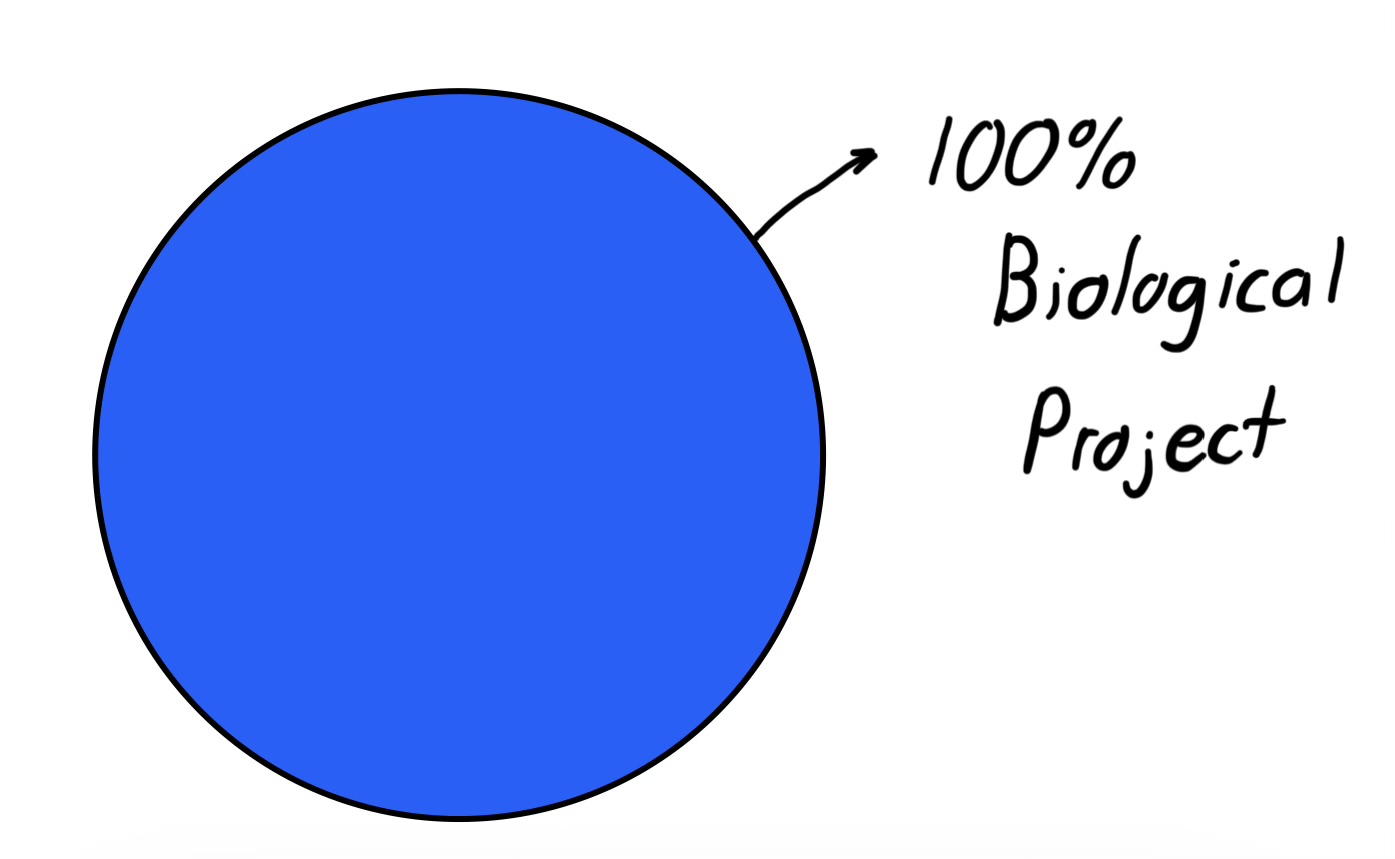
It basically doesn’t change from this for at least the first 5 years of our lives. Even our early Grade 1 crushes fit into the project. At around this age, children may begin to be introduced to religion (community), art (creative), and/or sport (status); their pie chart may begin to diversify.
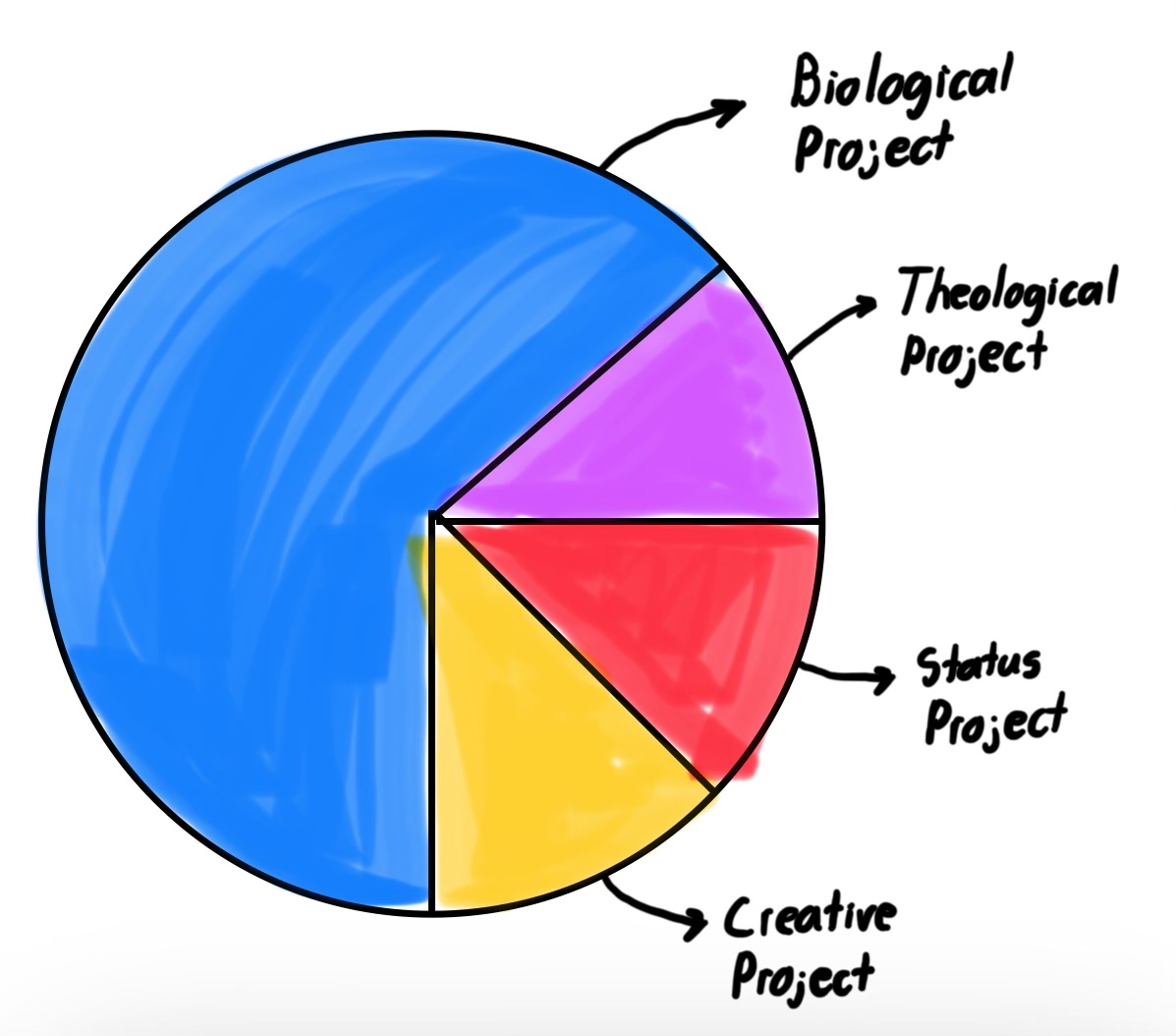
Every child has different experiences and therefore their pie charts may look vastly different. If your family is not religious then you probably wouldn’t have as large of, if any, a community project. Same goes for if you are not exposed to art or sport. Pie charts can change very quickly; for example, it’s common for kids to become obsessed with a sport. I believe professional sport is encompassed by two primary projects and one secondary. The primary ones are Status and Creative, and the secondary is Biological. While many athletes would struggle to admit it, the social status lift (fame) that comes from being good at a sport is highly motivating and is a large reason that people play sports. Once again, I am not saying this is a bad thing. We have a tendency to look down on people who openly admit their desire for fame. We love the humble superstar and cringe at the boastful bragger. However we have to remember that it really doesn’t matter, projects are “not good, not bad, not better, not worse, just is”. The other primary project for sport is Creative, and this is the one that encompasses the “love for the game”. This is the part of sport that encompasses the love of the challenge. One can make the argument that “sport is an art”; the best players look like artists in the way they run/kick/shoot.
Next: The Biological Project · Previous: The Immortal Replicator