I don’t have any tattoos, but if I did, it would say this:
not good, not bad
not better, not worse
just is
You’ll find that I try my best in this book not to make value judgments. What I mean by that is I try not to label anything as good, bad, better, or worse. Why? Well, put simply, I don’t think there is any good, bad, better, or worse way to live one’s life. I consider myself an optimistic nihilist, which means that I think life is meaningless, but I also don’t want to die. I figure even if it’s shitty, living and experiencing is better than not. I’m not afraid of death, it just seems boring. How do I know that? Well I’ve been there, back before I was born, and trust me it was not very exciting. Maybe you can relate.
The Why Game
In 2011, a fellow by the name of Jeffery Winter discovered that if you repeatedly click the first link on any Wikipedia page, 97% of the time you will end up at the page for “Philosophy”. Wikipedia articles are generally structured in a way where the first sentence in the article is the most general description of the page in question, and often the first hyperlink in that sentence is for whatever broader category the page fits in. By continually following the first link you are really asking what something is at a higher-level, almost like continually zooming out to broader and broader levels of detail.
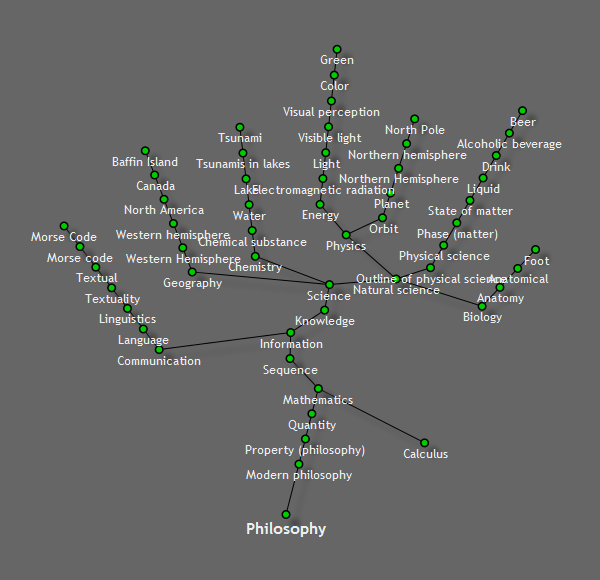
It’s a phenomenon that, while you may not have been able to predict it, when you hear it you don’t find it all that surprising. If I told you that all pages eventually point to the page for “muffin” you probably wouldn’t believe it, but “philosophy” makes some sort of intuitive sense you can’t quite explain. The word philosophy means “the love of wisdom”, and so it somehow makes sense then that by continuing to ask what something is (by clicking the first link), you end up at the page that basically represents the act of asking what something is.
Children between the ages of 2-4 go through a similar process, except they ask the much more difficult question of why. Let’s call it the Why Game. Like the Wikipedia phenomenon, repeatedly asking why almost always concludes at a common concept. Except in this case, instead of philosophy, its “we don’t know”:
Toddler: Why do we go to work? Adult: We go to work so we can earn money.
Toddler: Why do we need money? Adult: To pay for things like food, a house, and toys.
Toddler: Why do we need food and a house? Adult: To stay healthy and safe.
Toddler: Why do we need to stay healthy and safe? Adult: So we can be happy and enjoy life.
Toddler: Why do we want to be happy? Adult: Because it feels good.
Toddler: Why does it feel good? Adult: I don’t really know, it just does.
At first, these questions seem simple, but as anyone who has tried to answer a persistent child knows, they quickly cut to the core of our assumptions and knowledge. Much like the Wikipedia game leads to a foundational concept like philosophy, the Why Game has the potential to strip away surface-level reasoning and uncover deeper truths about our motivations and actions. This book, in its most basic description, is an attempt to play the Why Game from start to finish, from every angle.
Chances are, at some point, you were that toddler continually asking why. Then, after a host of unsatisfactory responses, you realized that no one, and I mean no one, really knows the answers. Moreover, no one really seemed all that concerned about answering these questions. Maybe they were interesting, but they didn’t put food on the table or a roof over your head. And so, my guess is that you unconsciously resigned from concerning yourself with these questions. They’re uncomfortable, and no one has the answers anyway, so screw em.
It’s a fair stance to take. However, if you’re willing, allow yourself to take this time and humor the curious child that’s still in there. I’m not asking you to give up the structure you have in your life, but for this time at least, let yourself indulge in the questions of “why”. It is my belief that many of the issues we face as humans would look different if more people revisited this childlike curiosity and understood the eventual conclusion of the Why Game—or, put more simply, uncovered the answer to the question: “Why do we do what we do?” By embracing this iterative process of questioning, we begin to unravel not just the mechanics of life, but the very essence of what drives us.
If you ask the question of “Why?”, again and again, all answers eventually boil down to a feeling. It is at this point where the questioning on the individual level can no longer progress, as the individual finds themselves in a constant loop of “it’s just how I feel”.
Try it yourself. Ask why you prefer one friend over another, why certain music moves you, or why you want kids (or don’t). Keep asking why until you hit bedrock. Eventually you’ll arrive at something like “it just feels right” or “I don’t know, it’s just how I am.” And that’s where the individual-level Why Game ends—not because you’re being evasive, but because feelings are the terminal point of introspection.
So, in order to answer the question of “Why do you feel that way?”, we have to zoom out from the individual level and examine humanity as a whole. Think about how we understand animals. We don’t ask a bird why it migrates south for the winter. We don’t interview a beaver about its motivations for building a dam. We observe their behavior, study their biology, and understand their drives through patterns. The bird doesn’t “know” why in any conscious sense—it just feels compelled to fly south when the temperature drops and daylight shortens.
Humans are no different. We’re just animals with the unfortunate ability to narrate our own experiences, which tricks us into thinking we actually know why we do what we do. We create elaborate stories to explain our feelings, but these stories are post-hoc rationalizations—justifications crafted after the feeling has already decided for us.
This is why the rest of this book takes an observational approach. Instead of asking people why they do things (which only produces those elaborate stories), we have to observe. We look at patterns across cultures and throughout history. We examine our evolutionary heritage. We study the architecture of the brain and the biochemistry of emotion. Not because feelings aren’t real—they absolutely are—but because the origins of those feelings can only be understood by stepping back and looking at the bigger picture.
In the same way that we can understand the motivations of animals without language, we can apply this same line of thinking to humans. Instead of asking, we have to observe.